Multi-wave mediation
in the China Family Panel Studies.
Does socioeconomic deprivation lead to depression through physical health, or do the two simply travel together? PhD research in progress.
- Group
- Professor Dora Y. Zhang, HKU
- Data
- China Family Panel Studies, 2016–2022
- Status
- In progress
- Estimates
- None published yet
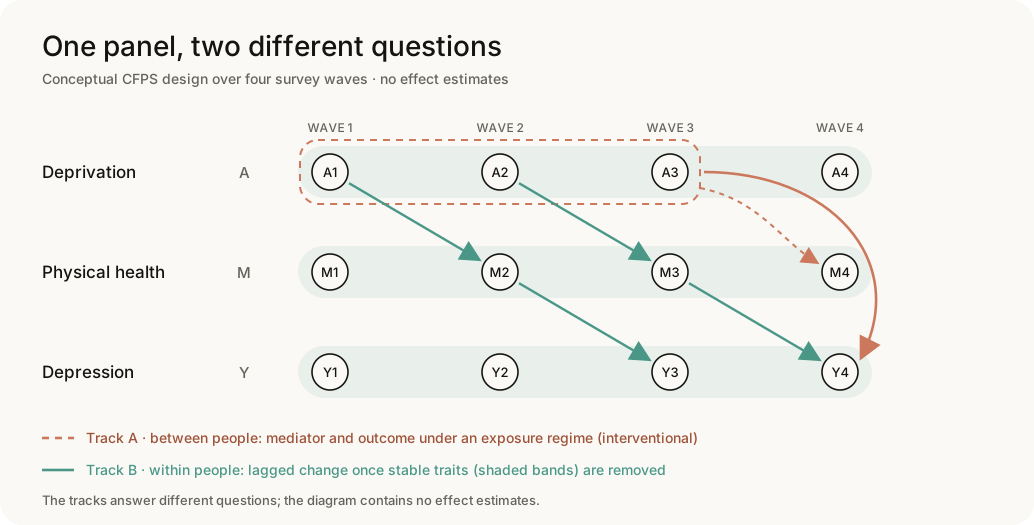
Mechanism, or selection?
People in deprivation are both less healthy and more often depressed. The question is whether deprivation works on depression partly through physical health, or whether people who are unwell or depressed are more likely to end up deprived.
Exposure, mediator and outcome by wave.
Track A uses deprivation in 2016, 2018 and 2020, physical health in 2018 and 2020, and depression in 2022. Earlier depression is modelled as a time-varying confounder, not used to filter the sample. Track B instead models repeated deprivation, health and depression together to separate stable differences between people from changes within people.
Two levels of evidence, kept apart.
- Track A follows the exposure trajectory through the health trajectory, with time-varying interventional effects identified by the mediational g-formula. It compares people, and can ask duration questions such as leaving deprivation against never entering it.
- Track B places health inside the within-person layer of a three-process random-intercept cross-lagged panel model. It follows the same person over time, and is the track that can speak to selection against causation.
The rule behind the split: no choice of waves turns a between-person contrast into a within-person one.
What this page does not show.
- No effect estimates appear here until identification and sensitivity analyses are final.
- Survey data are observational; every causal reading rests on stated assumptions.
A related lesson from this work: a negative control has to be able to fail.