Does the public checkpoint add value over simple baselines?
I separated forecast behavior from ranking and portfolio performance, then compared the public checkpoint with random, momentum and reversal strategies under the same backtest setup.
An independent evaluation of the public Kronos-small checkpoint and an inference-path optimization. Kronos itself is an upstream model by its original authors.
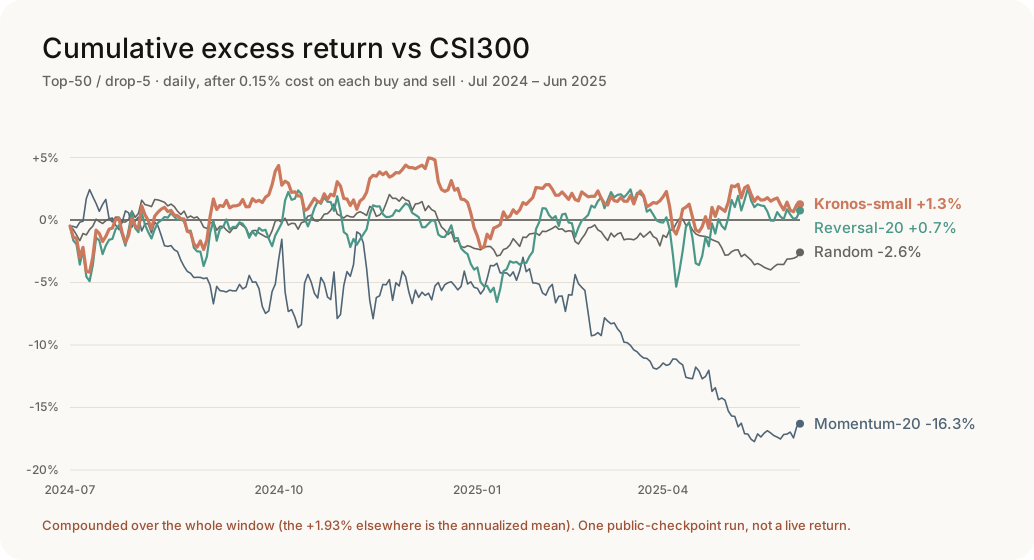
Redrawn from the evaluation’s daily reports: compounded excess over CSI300 after costs. The annualized mean, +1.93%, is the figure quoted elsewhere.
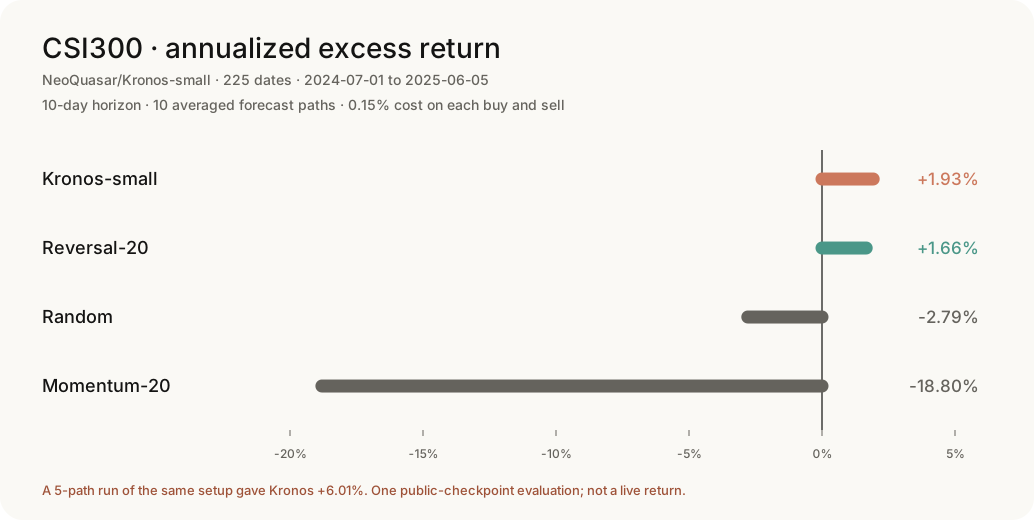
I separated forecast behavior from ranking and portfolio performance, then compared the public checkpoint with random, momentum and reversal strategies under the same backtest setup.
I traced the tokenizer and autoregressive prediction path, built a real-data walkthrough, evaluated the public model and implemented a bounded KV cache. On CPU, with a 400-bar lookback and 100 greedy steps, it ran 11.7 times faster with bit-identical output, for contexts within the model's valid length.
In this CSI300 run, Kronos-small recorded 1.93% annualized excess return after costs; the reversal baseline recorded 1.66%. A five-path run of the same setup gave Kronos 6.01%, and its ranking signal was not statistically significant (Newey–West p = 0.295). The chart keeps the weaker random and momentum comparisons instead of showing only the favorable pair.
This is not a numerical reproduction of the paper, whose best model, Kronos-large, is not public; nor is it a claim of general superiority or live performance. Its conclusions are limited to the checkpoint, data window, universe, costs and implementation used here. I did not pretrain or author the original Kronos model.