A forecast model,
tested against the simple.
An independent evaluation of the public Kronos-small checkpoint and an exact speed-up of its inference path. Kronos itself is an upstream model by its original authors.
- My role
- Evaluation, tracing, KV cache
- Upstream
- Kronos model and checkpoints by its original authors
- Period
- Jul – Sep 2026
- Checkpoint
- Kronos-small (public)
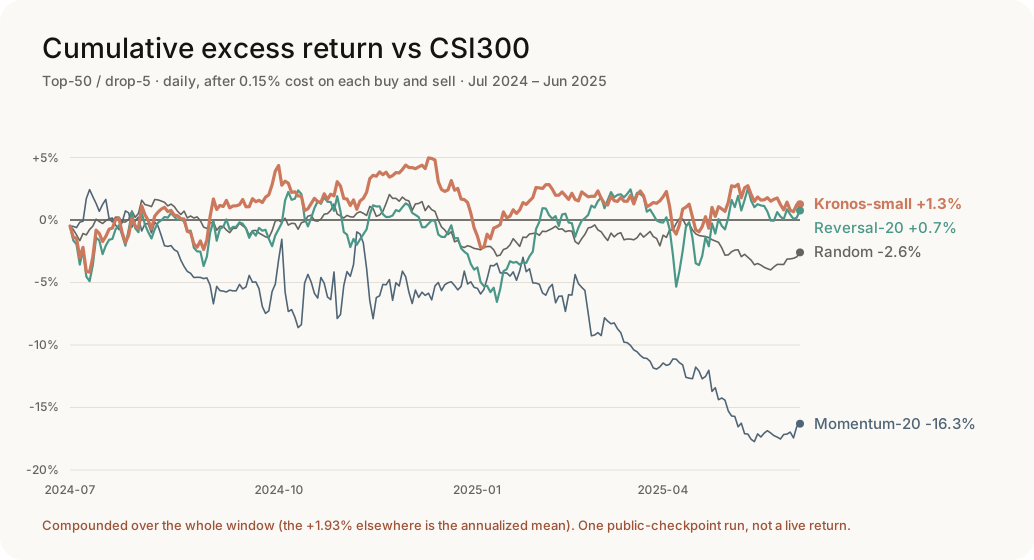
Redrawn from the evaluation’s daily reports: compounded excess over CSI300 after costs. The annualized mean, +1.93%, is the figure quoted elsewhere.
Does the public checkpoint add value over simple baselines?
I separated forecast behaviour from ranking and portfolio performance, then compared Kronos-small with random, momentum and reversal strategies under one backtest setup.
Evaluation, tracing and an exact speed-up.
I traced the tokenizer and autoregressive prediction path, built a real-data walkthrough, ran the evaluation and implemented a bounded KV cache: 11.7 times faster on CPU (400-bar lookback, 100 greedy steps) with bit-identical output, for contexts within the model’s valid length. I did not pretrain or author Kronos.
A modest result, kept in context.
With 10 averaged forecast paths, Kronos-small recorded 1.93% annualized excess return after costs; the reversal baseline recorded 1.66%. A five-path run of the same setup gave Kronos 6.01%, and its ranking signal was not statistically significant (Newey–West p = 0.295). The chart keeps the weaker random and momentum comparisons.
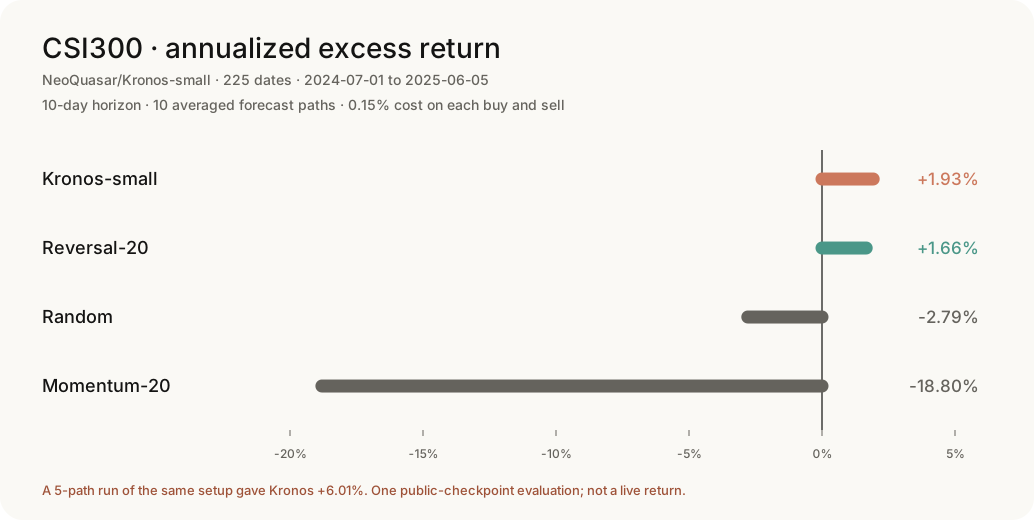
One public-checkpoint study.
- One checkpoint, one universe, one window, one cost model.
- Not a numerical reproduction of the paper, whose best model, Kronos-large, is not public.
- No claim of general superiority or live performance.